Apr 09, 2026
from Dr. med. Rosmarie Adelsberger
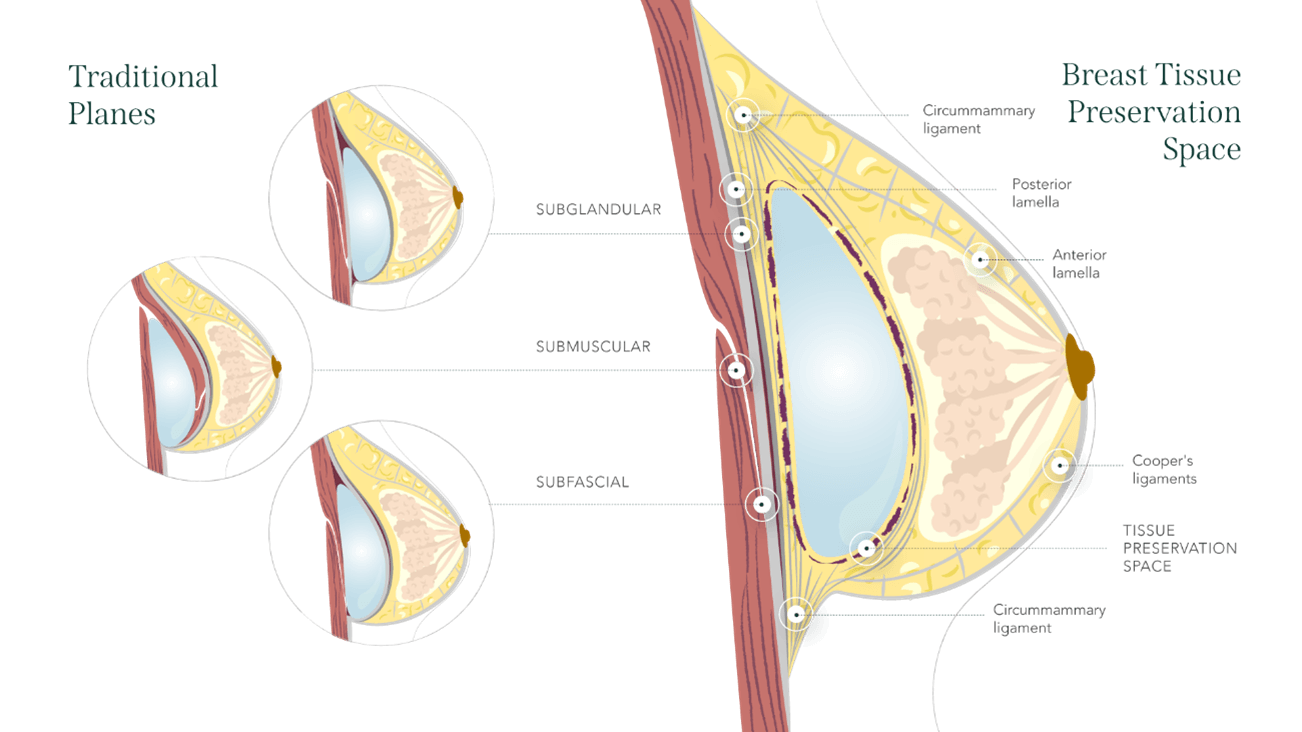
When it comes to breast augmentation, many patients focus primarily on the size and shape of the implant. This is a common misconception: in practice, it has been shown that the chosen surgical method has at least as great an influence on the result.
With the Preservé® technique, an approach has been developed that focuses specifically on tissue conservation. At the same time, classic breast augmentation remains the gold standard when precise shaping is required.
The central question is therefore not which method is more modern, but which is medically appropriate.
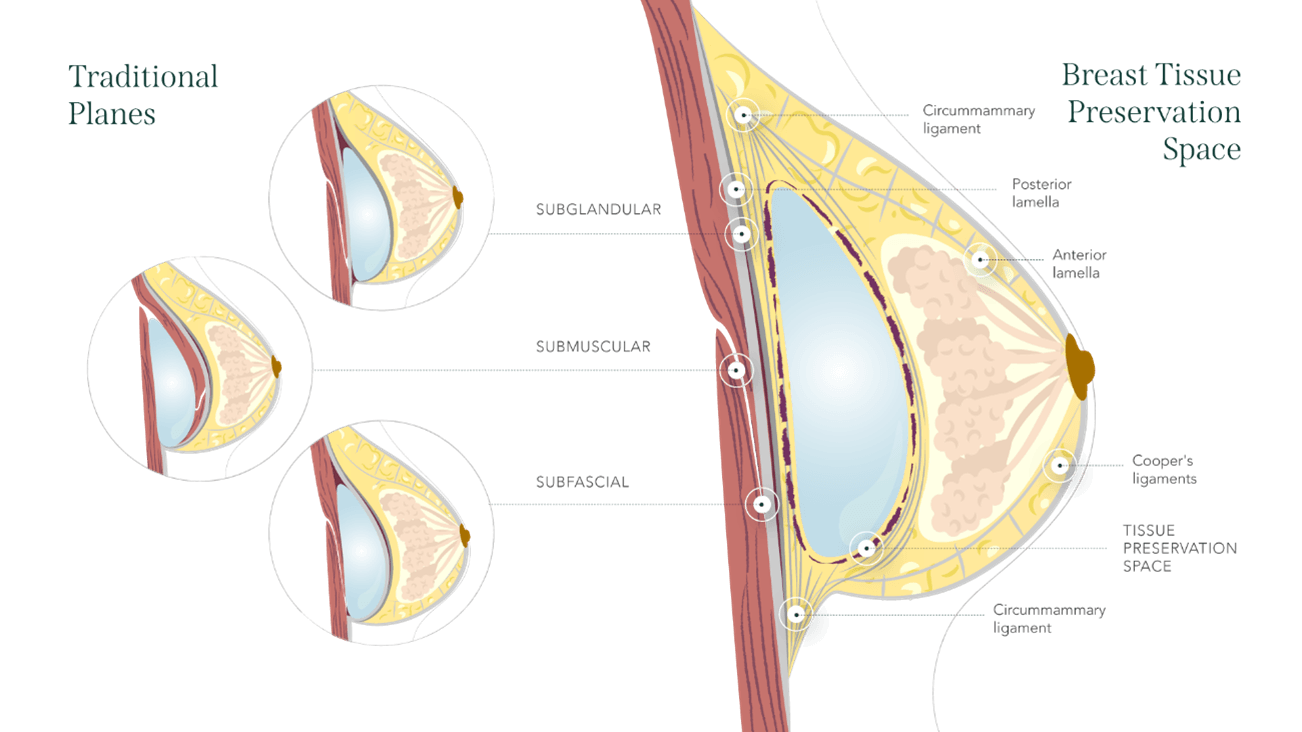
In classic breast augmentation, the implant is placed in a specially prepared pocket. This can be located either under the pectoral muscle (submuscular or dual plane) or above the muscle (subglandular or subfascial).
The decisive advantage of this technique lies in the surgical control. Thanks to the precise preparation, the implant position can be exactly defined and actively adapted to the desired breast shape.
In practice, it has been shown that this method is particularly superior when the initial situation is more complex - for example in the case of asymmetries, after pregnancies, with sagging tissue or when the tissue in the cleavage is too thin.
Classic breast augmentation allows the highest degree of control over shape, symmetry and implant position.
The Preservé® technique follows a reduced surgical procedure with the aim of changing the tissue as little as possible. In contrast to the classic technique, less tissue is removed and the pectoral muscle remains untouched.
The implant pocket is often gently expanded using a special balloon instead of undergoing extensive surgery. As a result, many patients feel less pain in the first few days after the operation.
The reduced post-operative pain with the Preservé®method is also due to the fact that the breast muscle is not dissected.
At the same time, the technical options are clearly defined. The implants are always placed over the pectoral muscle. Placement under the muscle, as with the classic technique, is not possible here. The implant size is also limited and in practice is usually a maximum of around 300 cc.
The Preservé®methodis designed for a limited implant sizeand placement above the muscle, which determines the patients for whom this approach makes sense.
Source: Motiva Preservé®
The main difference between the two methods lies not in the implant, but in the surgical strategy.
In practice, this means that the more complex the initial situation, the more important thepossibility of precise correctionbecomes.
The choice of method depends primarily on the anatomy and aesthetic goals - not on trends. A decisive factor is the thickness of the tissue in the upper breast area (décolleté).
If the tissue there is very thin, there is an increased risk of the implant becoming visible or palpable (so-called rippling). In these cases, the implant is often placed under the muscle or using the dual-plane technique. The muscle acts as an additional protective layer and reduces the risk of visible implant edges.
With very thin tissue in the décollet é, a submuscular implant position can significantly reduce the risk of visible rippling.
This option is not available with the Preservé® method. It is therefore particularly suitable for patients with clearly defined, simple initial situations and good tissue quality.
The classic technique is the better choice if additional corrections are necessary - for example in the case of sagging tissue, asymmetries or if more volume is desired.
A good result does not primarily depend on the method, but on the right indication. A precise analysis of the anatomy, realistic planning and surgical experience are crucial. A minimally invasive technique can only be convincing if it is suitable for the initial situation. Otherwise, it can unnecessarily limit the options.
Often yes, especially in the first few days after the operation. The main reason is that the breast muscle is not dissected.
No. They are different surgical strategies with clear possibilities and limitations.
Both methods can provide natural results. The decisive factor is the correct indication.
There is no general answer to this question. Every surgical procedure, including the Preservé method, has risks. The risks increase if the indication is not correct and the surgeon lacks the necessary experience.
No. The method is limited to certain anatomical conditions and smaller implant sizes.
The decision should be based on a sound medical analysis by experienced plastic surgeons - not on trends.
You can find more information about Motiva Preservé® here: https://motiva.health/de/surgeons-preserve/
Arrange your free consultation appointment directly online to get all your questions answered and see the Breast Atelier for yourself. Our specialists are at your disposal.
The medical team at Breast Atelier consists of doctors who specialize in plastic, aesthetic and reconstructive surgery. They have several years of professional experience and a recognized FMH specialist title.
The Breast Atelier consists of specialists with several years of professional experience who are under the medical supervision of Dr. med. Cédric A. George, the founder of the Pyramide Clinic (now Plastic Surgery Pyramide), which is renowned far beyond national borders. His center for plastic surgery has set the standard for quality and reliability in plastic reconstructive and aesthetic surgery.
Under the patronage of the Plastic Surgery Pyramid, these standards are also made accessible to a wider public in the Breast Atelier.

© 2026 Breast Atelier Zürich AG

Upwards
In Cooperation with: