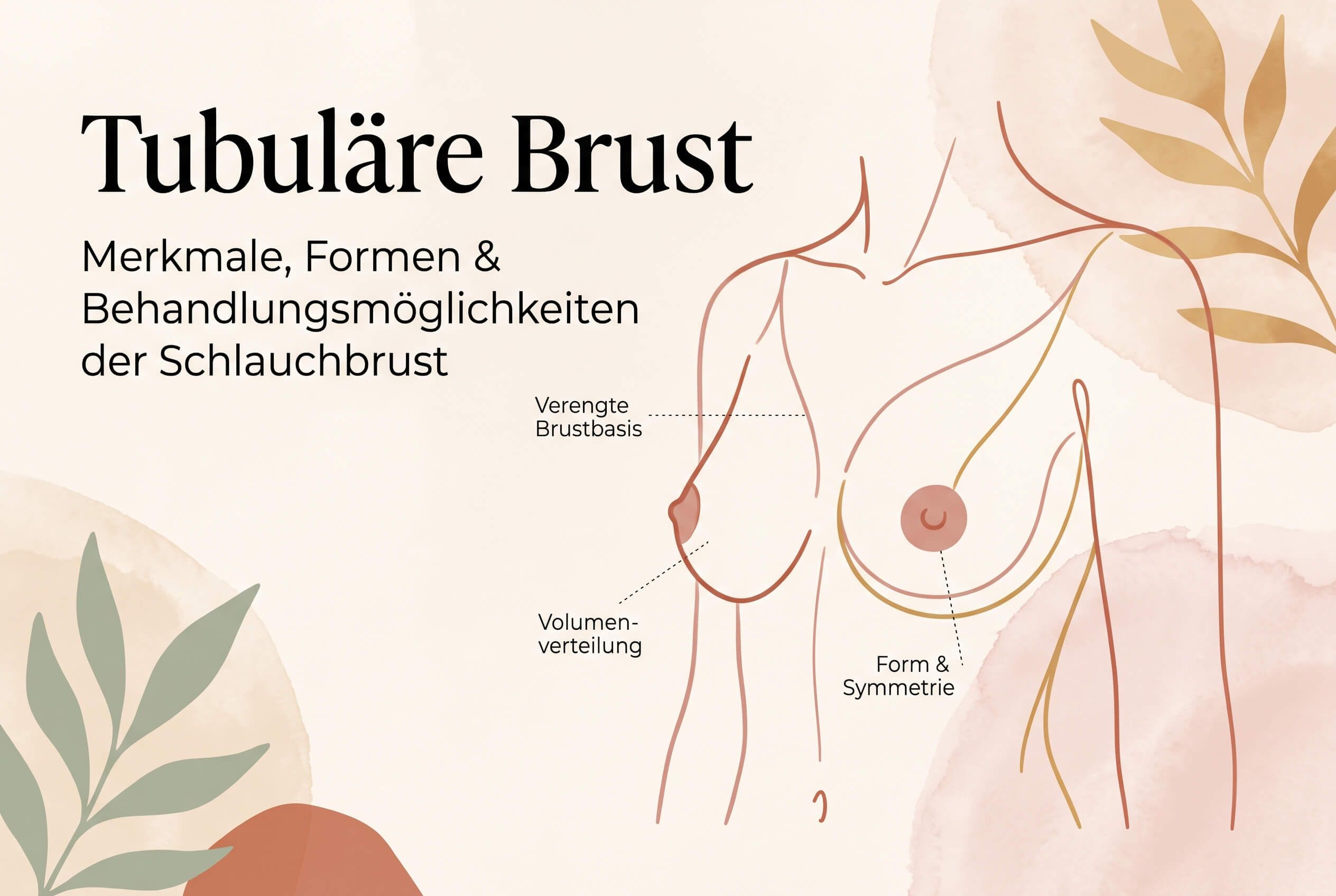
A narrow breast base, a lack of roundness in the lower breast area, and an enlarged, often protruding areola may be signs of tubular breasts. Accompanying asymmetries are also common. You may also have come across terms such as “tubular breast” or “tuberous breast” in this context. Medically speaking, this is a congenital developmental disorder that usually becomes apparent during puberty and can affect one or both breasts.
Type according to Grolleau (severity)
- Type I: The lower area, particularly the part facing the center of the breast, is less developed.
- Type II: The entire lower breast area is less developed.
- Type III: All four breast regions are affected. The breast base is usually significantly narrowed.
Since the two breasts may differ in severity, we assess each side individually during the planning phase and take into account how much skin and native breast tissue is present on each side (
specialized source).
Can I breastfeed with a tubular breast?
Breastfeeding is generally possible. If there is less milk-producing glandular tissue, the milk supply may be too low for exclusive breastfeeding. The shape of the breast alone does not provide much insight into this. Breastfeeding may still be possible even after corrective surgery; however, depending on the procedure, the ability to breastfeed may be reduced or eliminated.
When is corrective surgery recommended?
The shape of the breast generally does not require treatment. If you wish to undergo a correction, we usually schedule it after breast growth has been completed. How much the shape of your breast bothers you and whether you are planning a pregnancy can play a role in choosing the timing. A consultation is also available if you simply wish to receive a specialist evaluation. Source
How is a tubular breast corrected?
The primary goal is to reshape the lower part of the breast. Depending on the findings, we release constricting tissue structures, redistribute existing glandular tissue, and correct the inframammary fold. An implant or the injection of autologous fat (lipofilling) can increase volume. A significantly enlarged or protruding areola can be reduced through a lift.
What is the recovery period like after surgery?
Depending on the procedure, you’ll wear a compression bra; if implants are used, you may also need to wear a Stuttgart band. When you can return to work depends on the procedure and your job. You’ll generally need to avoid sports and strenuous activity for several weeks.
Does health insurance cover the costs?
In cases of a pronounced developmental abnormality with corresponding medical justification, insurance may cover the cost of surgical correction. If coverage is a possibility, we will submit a request for pre-authorization of costs on your behalf before the surgery, supported by a specialist’s medical justification.
Personal Consultation at the Breast Atelier Zurich
If you’d like to know whether you have tubular breasts or which correction is right for you, we’ll take the time to answer your questions. Together, we’ll discuss the findings, your wishes, and what outcome is realistic.