
Aug 19, 2026
from Caroline Sophie Fritz, M.D.
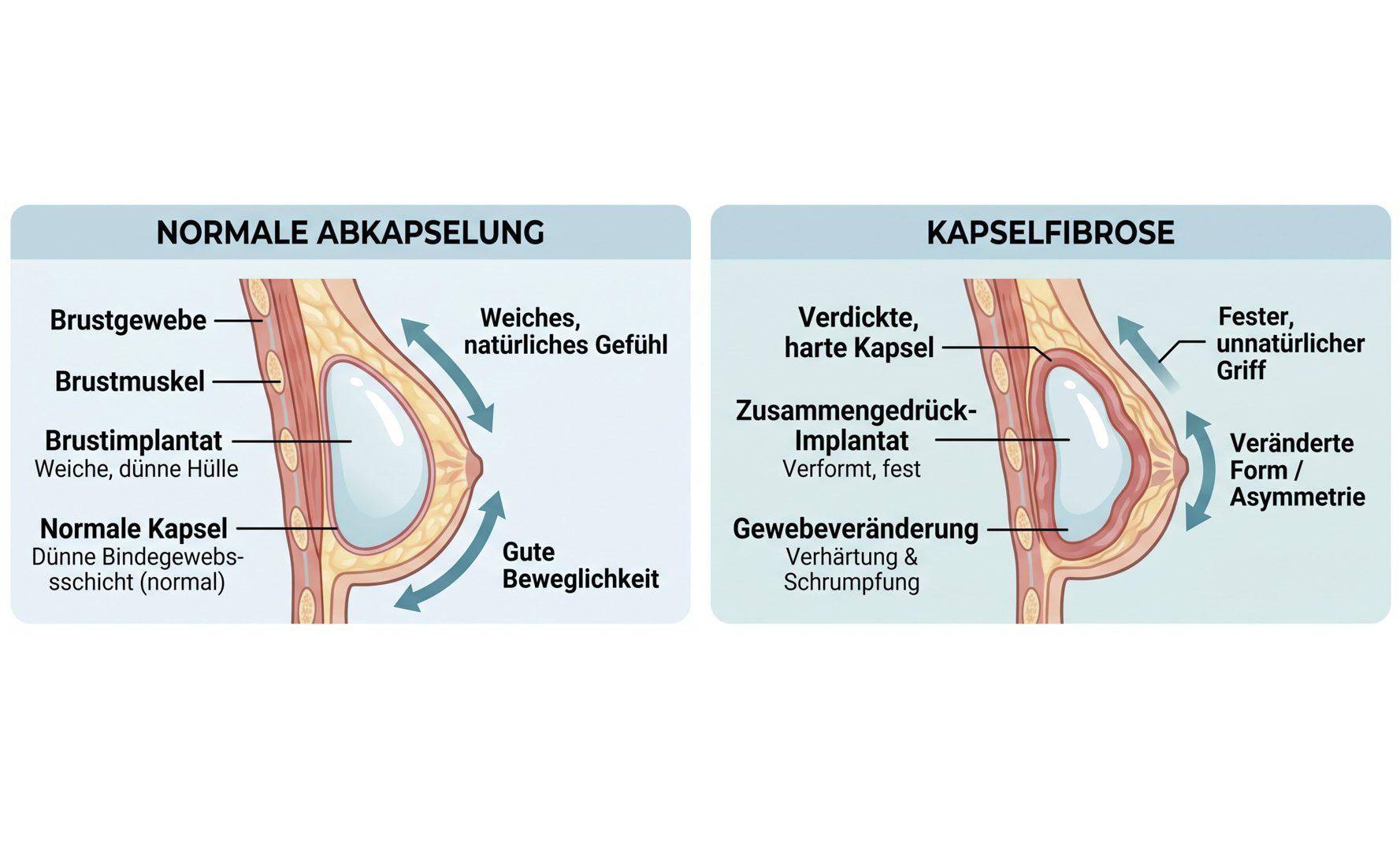
Breast augmentation is one of the safest and most commonly performed procedures in plastic surgery. Nevertheless, there is one issue that understandably often concerns patients: capsular contracture. In this article, we’d like to help you better understand this phenomenon, alleviate your fears, and highlight the modern options available today to minimize the risk and—should it occur nonetheless—treat it effectively.
After a breast implant is inserted, the body naturally forms a delicate capsule of connective tissue around the implant. This capsule serves to isolate the foreign body. Normally, this capsule is soft, thin, and imperceptible to the patient.
Capsular fibrosis occurs when this capsule pathologically thickens, becomes scarred, and subsequently contracts. This causes the implant to become “constricted,” which is noticeable as a hardening of the breast.
The exact causes are multifactorial. It is believed that the condition is triggered by an immunological reaction. Factors that may contribute to its development include:
To classify the severity, we in the medical community use the so-called Baker classification, which allows physicians to objectively describe the condition:
If you notice a change in the feel or shape of your breast, it is important to seek a professional evaluation. Following an examination by a specialist, imaging procedures are recommended for diagnosis:
The risk of capsular fibrosis can be significantly reduced today through modern standards and is less than 1% in our practice. At Breast Atelier, we rely on:
If you suspect capsular fibrosis: Stay calm. This is not a life-threatening condition or a medical emergency.
Surgery is by no means always necessary right away. We often monitor the progression together. However, if you experience significant distress due to pain or severe cosmetic deformity, we’ll plan the procedure at your convenience. The goal is usually to replace the implants and remove the scarred capsular tissue (capsulotomy). You can rest assured: Together, we’ll find a solution that meets your aesthetic expectations.
A common misconception is that follow-up costs after cosmetic surgery must always be paid out of pocket. When capsular fibrosis is diagnosed (especially once it reaches a certain severity), it is often classified as a condition requiring treatment. In many cases, health insurance plans therefore cover part of the costs for the necessary corrective surgery. We’re happy to assist you with the application process and communication with your insurance provider.
Do you have questions or have you noticed a change in your breast? Schedule your consultation appointment for an examination directly online —better safe than sorry. Our specialists are available to answer any questions or address any concerns you may have.
The Breast Atelier’s medical team consists of physicians specializing in plastic, aesthetic, and reconstructive surgery. They have several years of professional experience and hold recognized FMH board certification.
The Breast Atelier is comprised of specialists with several years of professional experience who work under the medical supervision of Dr. med. Cédric A. George, the founder of the Pyramide Clinic (now Plastic Surgery Pyramide), which is renowned far beyond Switzerland’s borders. His Center for Plastic Surgery has set the standards for quality and professionalism in plastic, reconstructive, and aesthetic surgery.
Scientific sources for further information on capsular fibrosis:
Ajdic D, Zoghbi Y, Gerth D, Panthaki ZJ, Thaller S. The Relationship of Bacterial Biofilms and Capsular Contracture in Breast Implants. Aesthet Surg J. March 2016;36(3):297-309. doi: 10.1093/asj/sjv177. Epub 2016 Feb 2. PMID: 26843099; PMCID: PMC5127460. https://pubmed.ncbi.nlm.nih.gov/26843099/
Spear SL, Baker JL Jr. Classification of capsular contracture after prosthetic breast reconstruction. Plast Reconstr Surg. Oct 1995;96(5):1119-23; discussion 1124. PMID: 7568488. https://pubmed.ncbi.nlm.nih.gov/7568488/
Zahavi, A., Sklair, M., & Ad-El, D. (2006). Capsular Contracture of the Breast: Working Toward a Better Classification Using Clinical and Radiologic Assessment. Annals of Plastic Surgery, 57(3), 248–251. https://doi.org/10.1097/01.sap.0000221614.32176.9a
Newman, A. N., & Davison, S. P. (2018). Effect of the Keller Funnel on the Rate of Capsular Contracture in Periareolar Breast Augmentation. Plastic and Reconstructive Surgery - Global Open, 6(6), e1834. https://doi.org/10.1097/GOX.0000000000001834
Li, DD., Lan, N., Zhao, P., et al. Advances in the Etiology and Prevention of Capsular Contracture After Breast Implantation. Aesth Plast Surg 49, 1915–1926 (2025). https://doi.org/10.1007/s00266-024-04500-5

© 2026 Breast Atelier Zürich AG

Upwards
Tel: +41 43 336 73 00
Fax: +41 43 336 73 01
info@breast-atelier.ch